
How to Write a Book Blurb That Actually Converts Fiction Readers
A book blurb is not a summary. That distinction matters more than most authors realize, and confusing the two is one of the fastest ways to tank conversion rates on a product page that would otherwise be performing.
Author coach Rebecca Hamilton has worked on blurbs across hundreds of fiction authors and dozens of genres, and the same problem comes up repeatedly: authors write blurbs that describe their book instead of selling it. The result is a product page that gets traffic and loses readers before they ever hit the buy button.
This post covers how a converting blurb actually works, what it needs to do, and the specific mistakes that kill conversions before ads ever get the chance to prove themselves.
Why Your Blurb Matters More Than Your Cover for Conversions
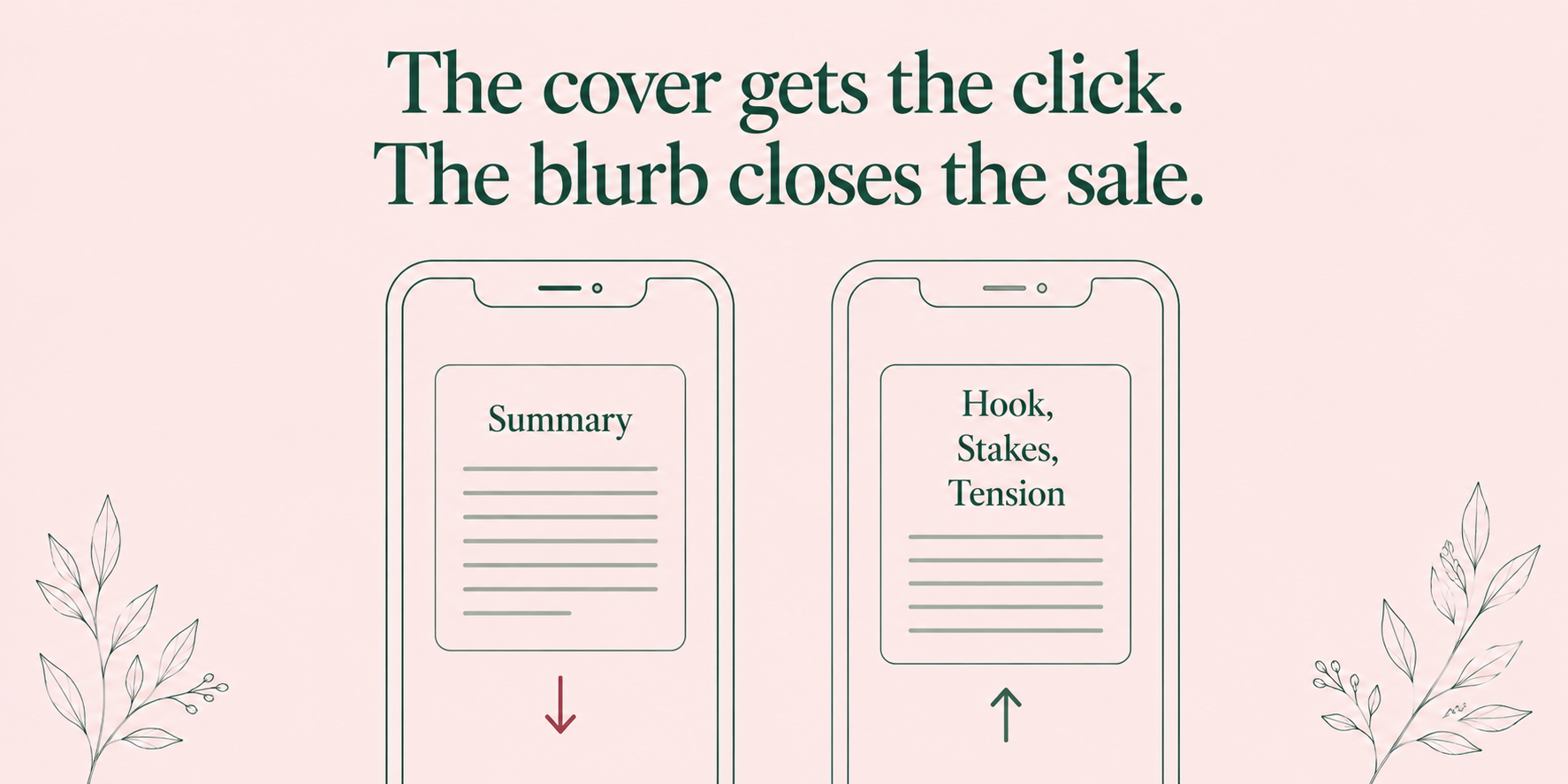
The cover gets the click. The blurb closes the sale.
A reader who taps on your book has already passed the first hurdle. The cover did its job. What happens next, in the five to fifteen seconds they spend on your product page, is entirely determined by your blurb and your opening pages.
This is why conversion rates are one of the most revealing metrics for fiction authors running ads. A strong CTR paired with consistently low conversion rates almost always points to something on the landing page, and the blurb is the first place to look. Sending more ad traffic to a page that does not convert does not fix the problem. It amplifies it.
It is also why the five marketability questions cover blurb alignment before any discussion of ads or promotion. Marketability begins with whether the product page accurately represents what the right reader is looking for, and a blurb that misses that mark makes everything else harder.
What a Converting Blurb Actually Does
A blurb has one job: make the reader want to know what happens next badly enough that buying the book feels like the only logical next step.
Every word should be doing one of three things: establishing who the story is about, what is at stake for them, and why the reader should care enough to find out how it ends.
That sounds simple. It rarely is in practice, because authors are too close to their own work. They know every subplot, every character arc, every thematic layer. All of that knowledge makes it extremely difficult to strip the blurb back to what a cold reader actually needs, which is just enough to feel the pull.
Understanding reader psychology is foundational here. Readers are not making a rational purchasing decision when they buy a novel. They are responding to an emotional trigger. A blurb that reads like a plot outline does not trigger anything. A blurb that puts the reader in the emotional experience of the story does.
This is also where market research intersects with blurb writing. Knowing what your reader is actually looking for, what emotional experience they come to your genre expecting, shapes every word choice in the blurb. An author who knows their reader writes a completely different blurb than one who knows their plot.
The Structure That Works for Fiction Blurbs
There is no single formula that works across every genre. But there is a consistent structure underneath the best-converting blurbs that holds regardless of whether the book is dark romance, epic fantasy, cozy mystery, or psychological thriller.
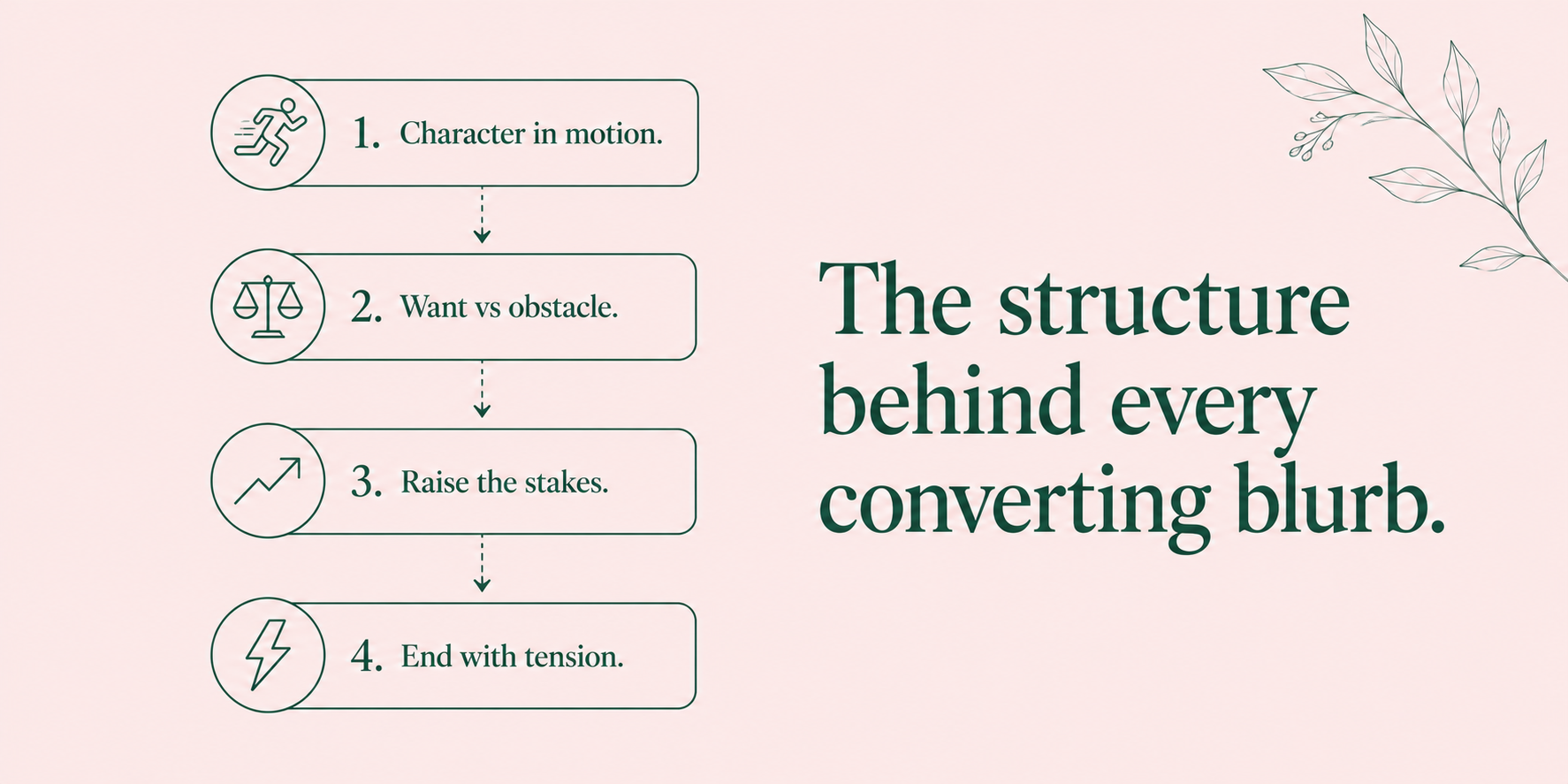
Open with the character in motion. Not backstory. Not setup. The reader in the story, in a situation that already has tension or stakes attached. The first line of a blurb should create a question the reader wants answered.
Establish what they want and what is standing in the way. This is the engine of the story, and it is what the reader is actually buying. Not the plot mechanics, but the emotional conflict driving them.
Raise the stakes. What happens if the character fails? What does losing look like? The more specific and the more costly the potential loss feels, the more urgency the blurb carries.
End with tension, not resolution. The blurb ends where the reader's curiosity takes over. Closing with a question, an unresolved choice, or an impossible situation pulls the reader forward into the sample pages or straight to the buy button.
This structure is also what Rebecca's team works through with clients inside the 3xP Reader Cloning System when optimizing backlist titles. A blurb revision that tightens these four elements consistently improves conversion rates without changing anything else on the product page.
The Mistakes That Kill Blurb Conversions
Writing a Summary Instead of a Hook
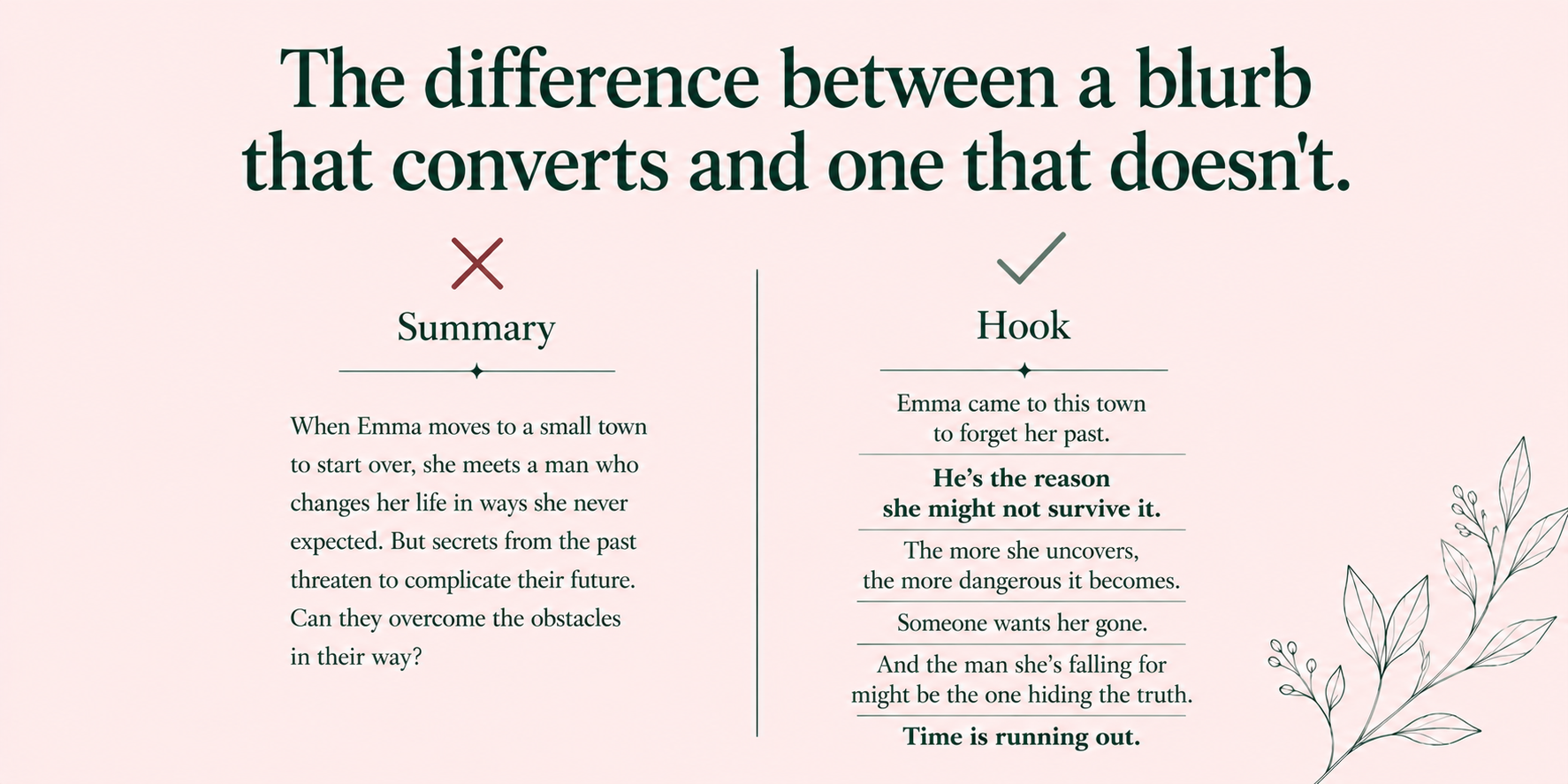
The most common blurb problem: authors summarize what happens in the book rather than creating the emotional experience of being in it. A summary tells. A blurb pulls.
"Sarah moves to a small town after a difficult divorce and starts a new life" is a summary. It tells the reader what has already happened. There is no tension, no forward momentum, nothing unresolved.
"Starting over was supposed to be simple. Sarah had done the hard part. She just hadn't counted on the town already knowing her name before she arrived, or what that meant for the secret she had spent five years keeping buried" creates a question the reader needs answered.
The difference is not about writing ability. It is about understanding what a blurb is for.
Burying the Hook
Some blurbs start with backstory or context and save the interesting part for the third paragraph. By that point many readers have already moved on. The hook belongs in the first line or the first two lines at the absolute latest.
This is also where the author blind spot shows up in blurb writing. Authors often assume readers will read the whole blurb the way they would read a chapter. Most do not. They skim, they decide fast, and they move on.
Overloading With Character Names and Plot Details
A blurb with three character names, two subplots, and a detailed explanation of the world-building is doing too much. The reader cannot hold all of it at once, and trying to process that much information breaks the emotional pull the blurb is supposed to create.
One protagonist. One core conflict. One reason to care. Everything else is detail that belongs inside the book, not on the product page.
Genre Misalignment
A romance reader picking up a blurb expects certain signals: the relationship, the tension between the leads, the emotional stakes of whether they end up together. A thriller reader expects a different set of signals entirely. A blurb that does not speak the genre's emotional language will lose the reader even if the book itself delivers everything they are looking for.
This comes back to why popular books succeed and what authors can actually learn from studying them. The blurbs of consistently high-converting books in any genre share a vocabulary, a rhythm, and a set of emotional triggers that readers of that genre have been trained to respond to. Understanding that pattern is part of what makes a blurb work.
Using Passive or Weak Language
Blurbs with passive constructions and hedging language lose urgency. "She finds herself drawn to" is weaker than "she wants him." "Things begin to spiral" is weaker than "everything she built starts to collapse." The blurb has limited space and every word should carry weight.
How the Blurb Connects to Your Ad Performance
A blurb problem shows up in ad data before most authors realize what they are looking at.
Strong CTR with low conversion rates is the clearest signal. The ad is working. The targeting is reaching the right people. The cover is compelling enough to get the click. And then something on the page is not closing the sale.
The blurb is the first thing to test in that scenario, before changing the ad, before adjusting the targeting, before increasing the budget. How book ad metrics work covers how to read that data correctly and identify where in the funnel the problem is actually occurring.
It also matters for sell through rates . A blurb that creates the right expectation for the right reader produces buyers who are primed to read the book and come back for the next one. A blurb that attracts the wrong reader, or creates inaccurate expectations, produces buyers who leave negative reviews and never return. That shows up in sell through data and, eventually, in the overall profitability of the ad campaign.
The connection between the blurb, the product page, and the ad is one of the core alignment principles inside the Seven Figure Author Career program , and why most authors think their Facebook ads are broken when the ads are actually doing exactly what they are designed to do.
Getting the Blurb Right Before Spending on Ads
The sequence matters. Getting started with ads before optimizing the product page is one of the most costly mistakes self-published authors make . Every dollar spent sending traffic to a page with a weak blurb is a dollar that could have converted into a sale and a returning reader.
Before running any ad campaign, the blurb should be tested. That does not have to mean a formal split test. It means reading it as a cold reader, stripping out everything only someone who already knows the story would understand, and asking whether the first line creates a question worth answering.
Finding the right editor also intersects here, because a developmental editor who understands your genre can often identify blurb problems before the book ever launches. Not every author needs outside help with their blurb, but authors who consistently struggle with conversion rates often find that a blurb revision done with fresh eyes produces an immediate improvement in their numbers.
For authors earlier in their career who are building the foundation before ads make sense, this guide to starting from zero covers where the blurb fits in the broader sequence of getting a book ready for the market.
What Comes Next
A converting blurb is one piece of a larger product page ecosystem. The opening pages, the categories and keywords driving organic discovery, and the review velocity all interact with the blurb to determine whether a reader who lands on the page becomes a buyer. Book launch strategy covers how to set up that ecosystem before launch so the algorithm is working in your favor from day one.
For authors who want hands-on blurb feedback as part of a broader strategy, the 3xP Reader Cloning System includes blurb revision support alongside the full catalog alignment work. The first step is applying for a free call with Rebecca's team to see whether the program is the right fit.
Want More of This?
Join the free Six Figure Fiction Facebook group where Rebecca shares live trainings, blurb feedback, and practical advice for building a six or seven figure author career.
Rebecca Hamilton is a New York Times, USA Today, and Wall Street Journal bestselling author as well as the ONLY Author Career Coach to help hundreds of authors hit national bestseller lists and make six to seven figures a year writing fiction. Her proprietary Reader Cloning System removes the guesswork and gets authors from where they are to where they want to be, as quickly as they wish to get there. 💕
