
How Book Ad Metrics Actually Work for Fiction Authors in 2026
Running ads and watching numbers go up and down without knowing what any of them are actually telling you is one of the fastest ways to burn through a budget and walk away convinced that ads just don't work.
They do work. The issue is almost never the ads themselves.
Rebecca Hamilton has been running and analyzing book ads for fiction authors for over a decade, and the metrics conversation comes up constantly, because most authors are measuring the wrong things, drawing conclusions too early, and making changes based on data they don't fully understand yet. This post breaks down what each metric is actually telling you and how to use them together to make decisions that improve your bottom line.
Why Book Ad Metrics for Fiction Authors Work Differently in 2026
Book advertising is not the same as advertising a physical product. The average minimum order value Facebook recommends for products being advertised through their platform is $50 to $75. The average book price is nowhere near that. Which means authors are competing for ad placements against businesses that can afford a much higher cost per click and still turn a profit.
That context matters before looking at any metric, because it shapes what "good" actually looks like for a fiction author versus what it looks like for someone selling a $200 product.
It also shapes why scaling Facebook ads works differently for authors than most ad guides suggest. What works at $10 a day does not automatically work at $100 a day, and understanding why requires understanding what happens inside the bidding system as spend increases.
Before running a single ad, though, the most important question to answer has nothing to do with the platform. These five marketability questions cover what needs to be in place on the product side before ad spend makes sense.

CPM vs CPC: What Fiction Authors Actually Need to Know
CPM stands for Cost Per Mille, meaning cost per 1,000 impressions. CPC stands for Cost Per Click.
The reason this comparison matters for fiction authors is that CPM and CPC ads reach different types of platform users. CPM ads are shown to users who engage with content. CPC ads are shown to users who click on things and, more importantly, tend to buy things. The setup of the ad determines which user type sees it, and that difference shows up directly in conversion rates.
A CPM ad might appear to have a lower cost per click on paper. But if the conversion rate on that ad is 1% and the conversion rate on a CPC ad with double the cost per click is 5%, the CPC ad produces five times as many sales from the same number of clicks. Paying twice as much per click while generating five times as many sales is not a problem.
CPC ads also carry a measurable advantage worth knowing: they produce 10% to 16.7% higher page views and 387% higher conversion rates compared to CPM ads.
That said, neither format tells you much without conversion data alongside it. A low CPM with weak conversions and a higher CPM with strong conversions are not equal, even if the click math looks similar. Understanding the Delayed Buyer Effect is also part of this picture, because conversions for fiction books often show up days or weeks after the initial ad impression, which means early data almost always understates real performance.
What Each Ad Metric Is Actually Telling You
Click Through Rate
CTR tells you whether the ad is resonating with the audience seeing it. A high CTR means the creative, the copy, or the headline is compelling enough that people are stopping and clicking.
What CTR does not tell you is whether those clicks are turning into sales. It is a signal of resonance with a specific audience, not a signal of profitability. Use it to compare ad creatives against each other. The ad with the higher CTR is connecting better with that audience. Whether that connection translates to revenue is a separate question.
Cost Per Click
CPC tells you how much each click is costing. Lower is generally preferable, but only when conversion rates hold up alongside it.
This is also the metric authors watch most closely when scaling, and where confusion tends to set in. As daily ad spend increases, the low-competition placements fill up and Facebook's bidding system moves into more competitive territory. CPC rises. Authors see this and assume something is wrong. Sometimes it is. Often it is just a predictable consequence of scaling, and the question to ask is whether net profit is still growing alongside it, not whether CPC has increased.
Cost Per Mille
CPM tells you the cost of reaching 1,000 people. It is most useful as a comparison tool between ad sets targeting similar audiences, to identify which placement is delivering the most exposure for the least spend.
On its own, CPM does not indicate whether those 1,000 people are the right ones or whether any of them are buying. Always cross-reference with conversion data before drawing conclusions from CPM alone.
Conversion Rate
Conversion rate is the percentage of people who clicked and then purchased. For fiction authors, this metric points most directly at the product page itself.
A strong CTR paired with a consistently low conversion rate almost always indicates something on the landing page, the blurb, the cover, the preview opening, or the price is not connecting with the reader who arrived. The ad got them there. Something on the page sent them away.
This is one of the reasons market research and reader psychology are foundational work before running ads, and why the blind spot most authors don't see often shows up in conversion data long before authors realize what is happening.
For authors in Kindle Unlimited, conversion tracking is more complicated because KU reads do not register as purchases in standard attribution windows. This is one of the areas where specific tools inside the 3xP Reader Cloning System adjust the calculation to give a more accurate picture.
Sell Through Rate
Sell through rate tells you how many readers who bought book one went on to buy book two, book three, and beyond. This single metric has more impact on ad profitability than most authors realize.
A reader is rarely just worth the price of one book. If sell through from book one to book two is 74%, and from book two to book three is 82%, and those readers keep buying, the value of every ad-generated sale compounds significantly beyond the initial purchase price. The ad that looked marginally profitable based on the first sale alone becomes substantially profitable once the full reader journey plays out.
Low sell through is also one of the clearest signals that something in the product itself needs attention, not the ads. More ad spend pushing readers into a catalog that does not retain them does not fix the retention problem. Reader psychology and series structure are where that gets addressed, and doing that work before scaling ad spend makes every dollar go further.
Lifetime Reader Value
Lifetime Reader Value is the total amount a single reader is projected to spend across the full catalog, factoring in sell through rates, series length, and average book price.
This number sets the ceiling on what can be spent to acquire a reader and still be profitable. An author with a Lifetime Reader Value of $2.43 has a very different CPC tolerance than one with a Lifetime Reader Value of $12.42. Running ads without knowing this number means setting budgets without knowing whether the math can ever work.

Net Profit: The Number That Actually Tells You If Ads Are Working
Every metric above feeds into net profit, and net profit is the number that matters most.
ROI gets attention because it is easy to calculate and looks meaningful. But a 100% ROI on $100 spend produces $100 in net profit. A 75% ROI on $1,000 spend produces $750 in net profit. The ROI dropped. The actual money earned is 7.5 times higher. That is the number that grows a business.
Net profit calculation: total gross earnings from the ad period minus total ad spend for the same period. For longer sell through windows, use Lifetime Reader Value to project the full value of the sales generated rather than waiting months for all the revenue to surface.
To show why every metric matters and none of them work in isolation, here is a comparison using real numbers from Rebecca's framework:
Starting point: $0.10 CPC, 984 clicks, $101.55 spent, 9% conversion rate, 74% sell through book one to book two, 82% book two to three, 88% book three to four. Net profit: $647.13.
Adjust only the CPM downward with conversion rate dropping to 5%: spend drops to $77.21 but net profit drops to $509.51. Lower CPM, worse result.
Drop sell through from book one to book two to 20%, everything else the same: net profit drops to $260.52.
Drop conversion rate to 1%, everything else the same: net profit goes negative.
Now take that negative scenario and increase Lifetime Reader Value from $2.43 to $12.42: net profit recovers to $96.36 and turns profitable again.
The takeaway is not that one metric needs to be perfect. Often a small improvement across several metrics produces a much larger improvement in net profit than a single dramatic change to one number. This is why authors who work hard and still don't scale are often closer to a solution than they think. The problem is rarely catastrophic. It is usually a collection of small things pointing in the wrong direction simultaneously.
What to Fix First When the Numbers Are Off
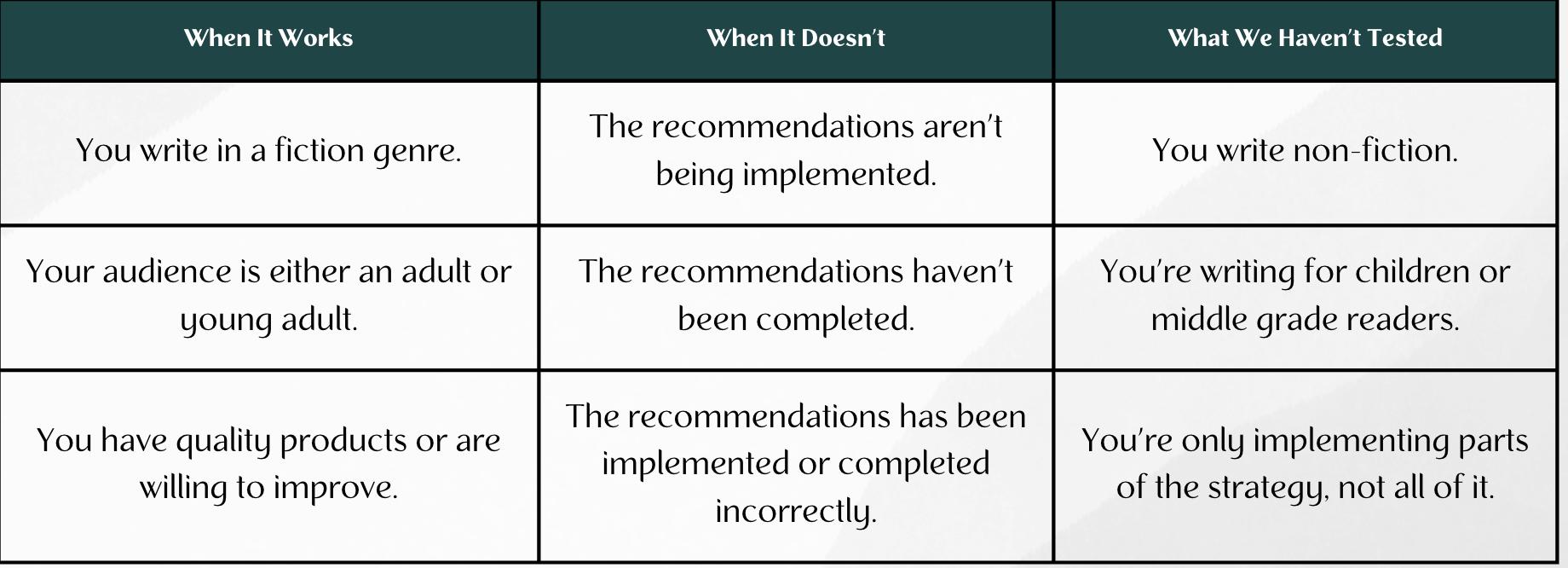
If conversion rates are low, start with the product page before touching anything in the ad account. Stronger targeting sending traffic to a weak landing page produces more of the same result. These costly mistakes show up regularly in the conversion data of authors who keep adjusting ads instead of addressing what the data is actually pointing at.
If sell through is low, the catalog structure needs attention before scaling ad spend. What makes books addictive and unputdownable is a useful place to start, because sell through problems are almost always about how the reading experience ends and whether it compels the reader to pick up the next book.
If CPC is rising but net profit is still growing, that is not a crisis. If CPC is rising and net profit is shrinking, that is when to evaluate whether targeting needs adjustment, whether the ad needs to be rebuilt, or whether the campaign needs a pause. How often Facebook ads need to be refreshed covers the patterns to watch for and when to act on them.
And if the ad account overall feels like it is not delivering, it is worth reading why most authors think their Facebook ads are broken before making changes, because the diagnosis is frequently different from what authors assume.
Building on This Foundation
Metrics are only useful when the targeting feeding them is solid. Part 1 of the book ad targeting series covers how fiction authors should actually identify their audience before running ads, and Part 2 will cover why the most repeated targeting advice is working against most authors who follow it.
For authors who want to go deeper into the full system behind the metrics, the advertising support inside the 3xP Program includes specific tools for calculating Lifetime Reader Value, tracking attribution data, measuring true conversion rates for KU authors, and identifying exactly where in the metrics chain adjustments will have the most impact.
Want More of This?
Join the free Six Figure Fiction Facebook group where Rebecca shares live trainings, weekly ad coaching, and ongoing support for fiction authors building toward six and seven figures!
Rebecca Hamilton is a New York Times, USA Today, and Wall Street Journal bestselling author as well as the ONLY Author Career Coach to help hundreds of authors hit national bestseller lists and make six to seven figures a year writing fiction. Her proprietary Reader Cloning System removes the guesswork and gets authors from where they are to where they want to be, as quickly as they wish to get there. 💕
