
Why the Book Ad Targeting Advice Fiction Authors Keep Hearing Is Wrong (Part 2)
There is a piece of targeting advice that gets repeated constantly in author communities, on YouTube, in Facebook groups, in courses, and in coaching programs. It sounds logical. It is easy to follow. And for most fiction authors, it quietly makes their ads worse.
This is Part 2 of a two-part series on book ad targeting for fiction authors. Part 1 covered who your audience actually is, the mindset shift that changes how targeting decisions get made, and the three barriers that stop most authors before they ever run a single ad. This post covers why the most commonly repeated targeting advice is working against the authors who follow it.
The Also-Boughts Problem
The advice in question: look at your also-boughts and use those authors as your ad targets.
It makes sense on the surface. If readers who bought your book also bought books by another author, those two audiences should overlap. Target that author's readers and you reach people already predisposed to your books.
Author coach Rebecca Hamilton disagrees with this approach, and the reasons go deeper than most authors realize before they try it and hit the same walls.
Why Also-Boughts Create Algorithm Risk
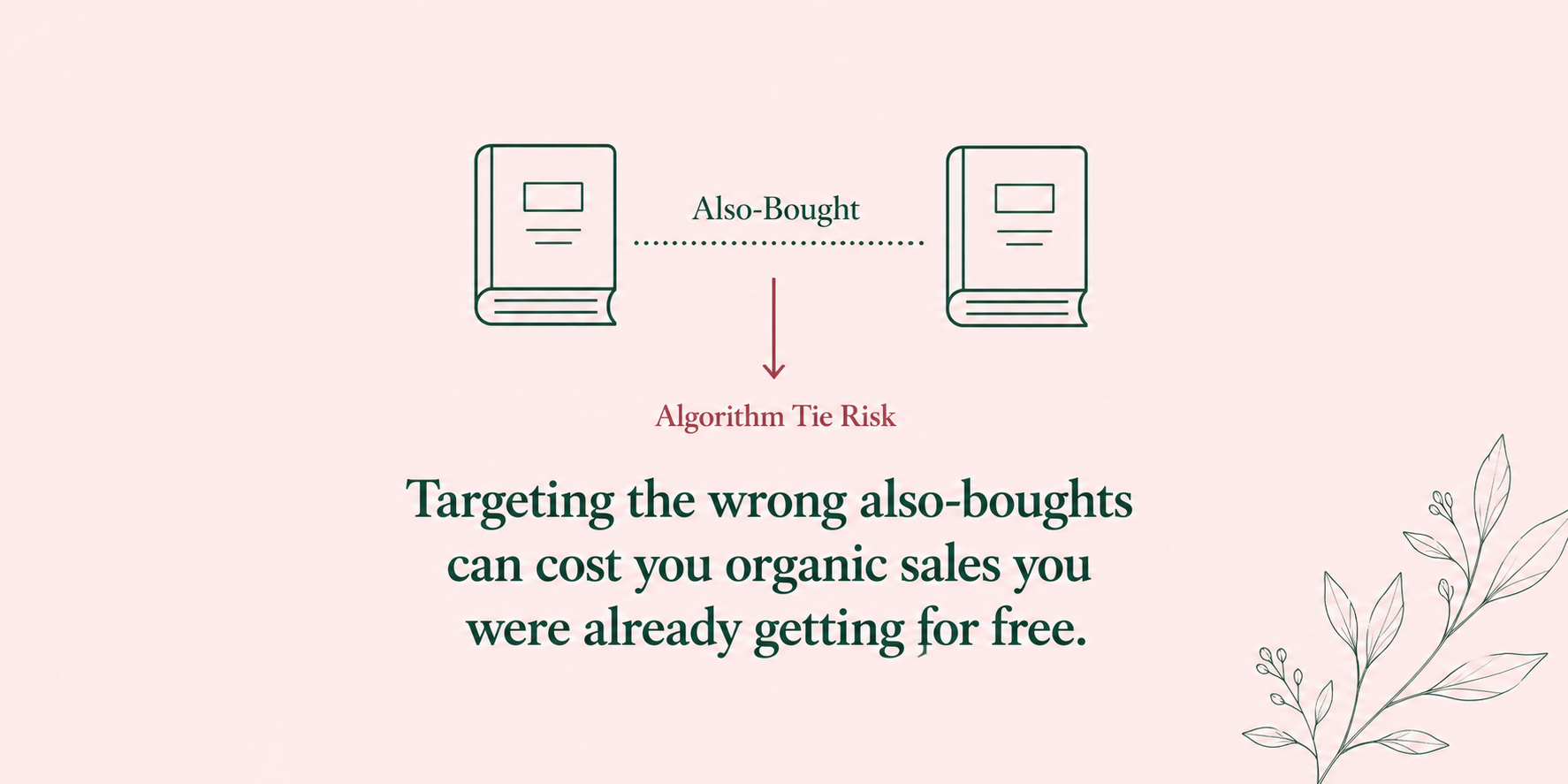
Also-boughts are not just a data point. They are one of Amazon's most powerful algorithm signals. When your book appears consistently in the also-boughts of another title, Amazon begins associating the two. That association affects organic recommendations, meaning who Amazon shows your book to for free, outside of any ad spend.
Using AMS ads to target an author in your also-boughts reinforces that tie. If the author you are targeting is building momentum, that works in your favor. If that author's sales are declining, or if their readership does not actually align with what your books deliver, you are tying yourself to a catalog that is heading in the wrong direction. The organic traffic you were getting for free can start to dry up while you are paying to maintain the same gross profits you had before, which is a worse net position than where you started.
This is a dynamic that plays out across the full author business, not just inside the ad account. Why scaling Facebook ads drops your ROI covers exactly how targeting decisions compound over time and why some authors find that increasing spend actually makes things worse rather than better.
Understanding how ads interact with everything else in your catalog is also part of what the 3xP Reader Cloning System is built around, because no ad strategy exists in isolation from the product and ecosystem underneath it.
The Practical Problem With Also-Boughts on Facebook
Setting aside the algorithm risk entirely, there is a practical problem that makes also-boughts an unreliable targeting source on Facebook specifically.
Having run ads for a large number of authors including many of the bigger names across several genres, Rebecca has a clear picture of which authors are actually selectable as Facebook targeting options. The overwhelming majority of authors that appear in a client's also-boughts are not available as interest targets on Facebook. Chasing them as a source for Facebook targeting leads to frustration before it leads to results.
The authors who do show up as Facebook targeting options are, in most cases, authors who were well established as known names in publishing before around 2012. Newer bestsellers, authors who have gotten television or film deals, authors who are currently dominating their genre's bestseller list: many of them are still not selectable. The platform's targeting database does not update at the pace the market does.
This is one of the reasons Facebook ad targeting for fiction authors focuses on reader behavior signals and adjacent interest targeting rather than direct author name matching, and why why most authors think their Facebook ads are broken is almost never actually about the ads themselves.
Where to Actually Find Targeting Ideas
If also-boughts are an unreliable starting point, where should fiction authors look instead?
Authors established before 2012. These are the names most likely to exist as selectable targets on Facebook. A well-known name from a decade ago is far more likely to be in Facebook's interest database than a current bestseller.
Google searches for genre authors. Searching for something like "paranormal romance authors" or "dark fantasy authors" pulls from aggregated sources across the web where more of the listed authors tend to be selectable as Facebook targets, compared to what shows up on current bestseller lists.
Goodreads Listopia lists. Lists with a high number of votes tend to surface authors with a longer track record, which correlates to higher selectability on Facebook.
Amazon and other bestseller lists for AMS and BookBub. Authors who are currently selling well may not be selectable on Facebook but they are more likely to be viable as AMS or BookBub targets, where the data is more current.
Ad platform suggestions, with caution. Facebook's own suggestions can surface additional targeting ideas worth testing, but they require research before adding. The question to ask before targeting any author is whether readers of that author's books would also enjoy your books. A high heat contemporary romance reader and a high heat fantasy reader may overlap significantly even though the umbrella genres are different. A small town romance reader and a dark thriller reader likely do not, even if both appear in the same suggestions list.
Reader communities. Fiction readers gather in Facebook groups, on The StoryGraph, on BookBub, and in BookTok communities. Browsing what authors come up repeatedly in those conversations can surface targeting ideas that never appear on bestseller lists or in platform suggestions.
Adjacent interests. When direct author targeting options are limited, broader interest-based targeting can open up viable audiences. Fantasy readers may overlap with Dungeons and Dragons communities or mythology groups. Romance readers often engage with trope-specific groups. Thriller readers may overlap with true crime audiences.
The Question That Replaces Also-Boughts
The reframe that makes all of this simpler: instead of asking which authors are in your also-boughts, ask whether readers of a specific author would also enjoy your books.
Those are different questions and they produce different answers. The first is about data that already exists in your account. The second is about reader behavior and genre alignment, which is what actually determines whether a target converts.
This is also why market research for fiction authors is foundational before ad targeting decisions. And understanding reader behavior at a deeper level, meaning what makes readers feel compelled to keep buying, is what reader psychology is actually about. A reader who finishes your book and immediately wants the next one is a very different targeting data point than a reader who bought once and moved on.
Before any of this targeting work begins, the five marketability questions are worth working through. If the product is not aligned with the audience being targeted, better targeting just delivers the wrong result faster.
Platform Targeting Is Not Transferable
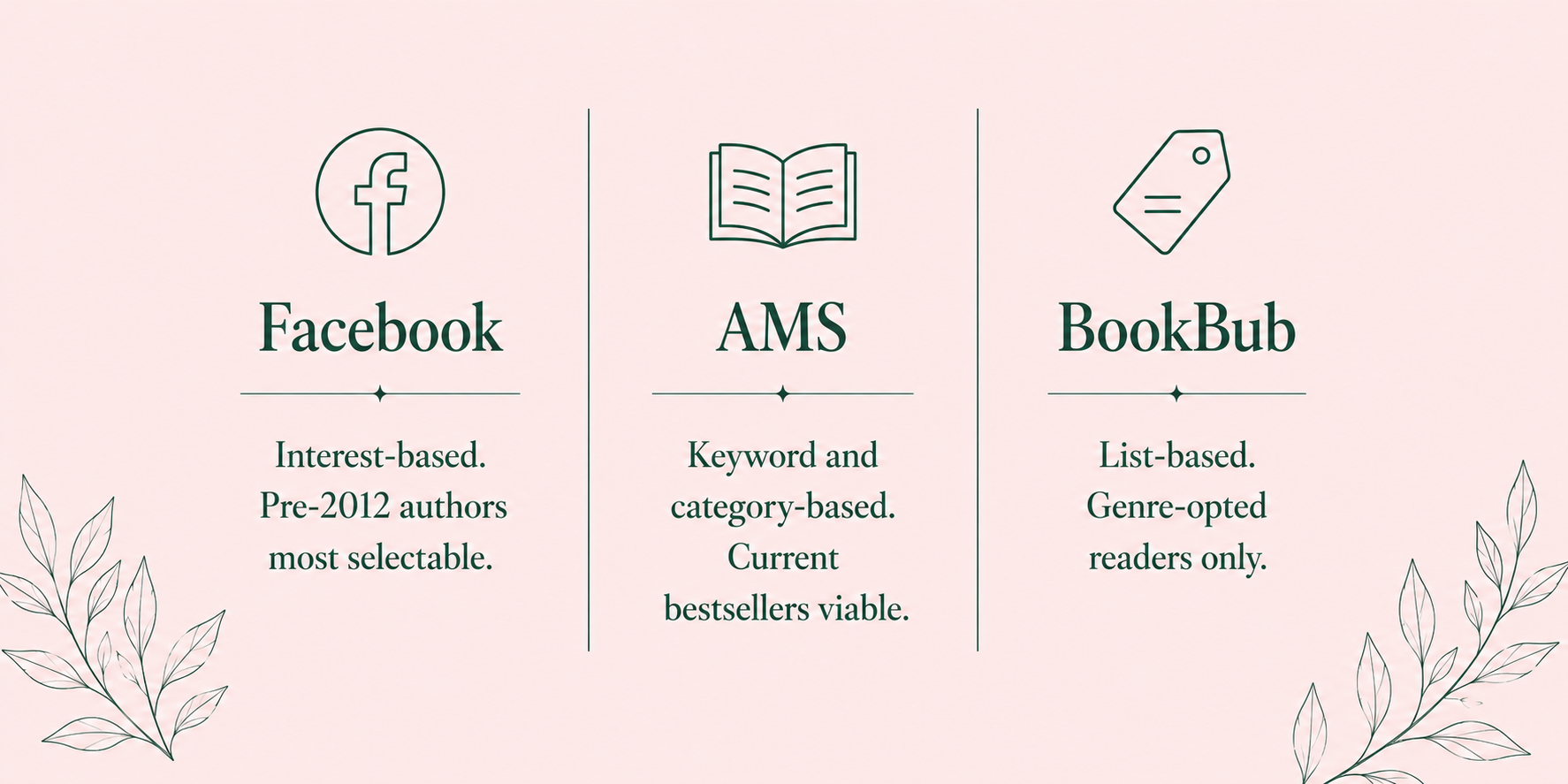
Facebook targeting, AMS targeting, and BookBub targeting operate on completely different data structures. What performs on one platform will not automatically translate to another.
Facebook targeting is interest-based, which is why author selectability is tied to how long an author has been generating interest data on the platform. AMS targeting is keyword and category-based, meaning it responds to what readers are actively searching for. BookBub targeting is list-based, reaching readers who have explicitly opted into genre-specific recommendations.
Understanding these differences also intersects with how conversion data should be read across platforms. The Delayed Buyer Effect plays out differently depending on where a reader first encounters an ad, and drawing conclusions from early data without accounting for platform-specific conversion windows is one of the most common reasons authors abandon campaigns that were actually working.
The full picture of how to read that data correctly is covered in how book ad metrics actually work for fiction authors in 2026. And for authors wondering how long to run a campaign before making changes, how often Facebook ads need to be refreshed covers the lifecycle patterns to watch for.
Why Bad Targeting Advice Keeps Circulating
The also-boughts advice can work if the authors in your also-boughts happen to be growing, happen to be selectable on the platform you are using, and happen to have a readership that genuinely aligns with yours. That combination does occur. But the advice gets taught as a rule rather than a conditional, which is why so many authors follow it and hit walls that feel inexplicable.
This pattern across book marketing is something Rebecca has documented extensively. Why so much of the advice authors find online keeps them stuck is not a mystery. It is a natural result of content being optimized for search traffic rather than for author outcomes. And why you have done everything right and your book sales still don't reflect it goes deeper into why talented authors following standard advice consistently plateau at the same place.
Targeting Is One Piece of a Larger System
Even well-researched targeting will underperform if the product it is sending traffic to is not ready to convert. A cover that does not match genre expectations, a blurb that does not land, a preview that does not pull the reader in: all of these show up in conversion data before authors realize what the actual problem is.
The author blind spot is costly for exactly this reason. The metrics point at the problem but only if you know what each number is actually telling you. And the costly mistakes most self-published authors make frequently show up in targeting performance before authors connect what they are spending money on with why the numbers look the way they do.
When the full system is in place, ads stop being unpredictable. The targeting, the product, the metrics, and the series ecosystem all work together rather than in isolation. That is what the 3xP Reader Cloning System is built around, and why the authors inside the Seven Figure Author Career program consistently find themselves making more while doing less.
Want to Go Deeper?
Join the free Six Figure Fiction Facebook group where Rebecca shares live trainings, ad coaching, and practical advice for building a six or seven figure author career.
Rebecca Hamilton is a New York Times, USA Today, and Wall Street Journal bestselling author as well as the ONLY Author Career Coach to help hundreds of authors hit national bestseller lists and make six to seven figures a year writing fiction. Her proprietary Reader Cloning System removes the guesswork and gets authors from where they are to where they want to be, as quickly as they wish to get there. 💕
