
What Is the Reader Cloning System and How Does It Work for Fiction Authors?
If you have spent any time inside Rebecca Hamilton's world, you have heard the term Reader Cloning System. But what it actually is, how it works, and why it produces results that standard book marketing advice cannot, rarely gets explained in full.
This post covers all of it.
Author coach Rebecca Hamilton developed the Reader Cloning System after years of logging data, testing theories, and watching what actually moved the needle across hundreds of fiction authors in different genres at different career stages. The result is a framework that does not rely on social media virality, rapid release schedules, or any single platform's algorithm staying consistent. It is built to compound over time and keep producing results even when you stop actively pushing.
Why Standard Book Marketing Keeps Fiction Authors Stuck
Before getting into how the system works, it helps to understand why most approaches do not scale.
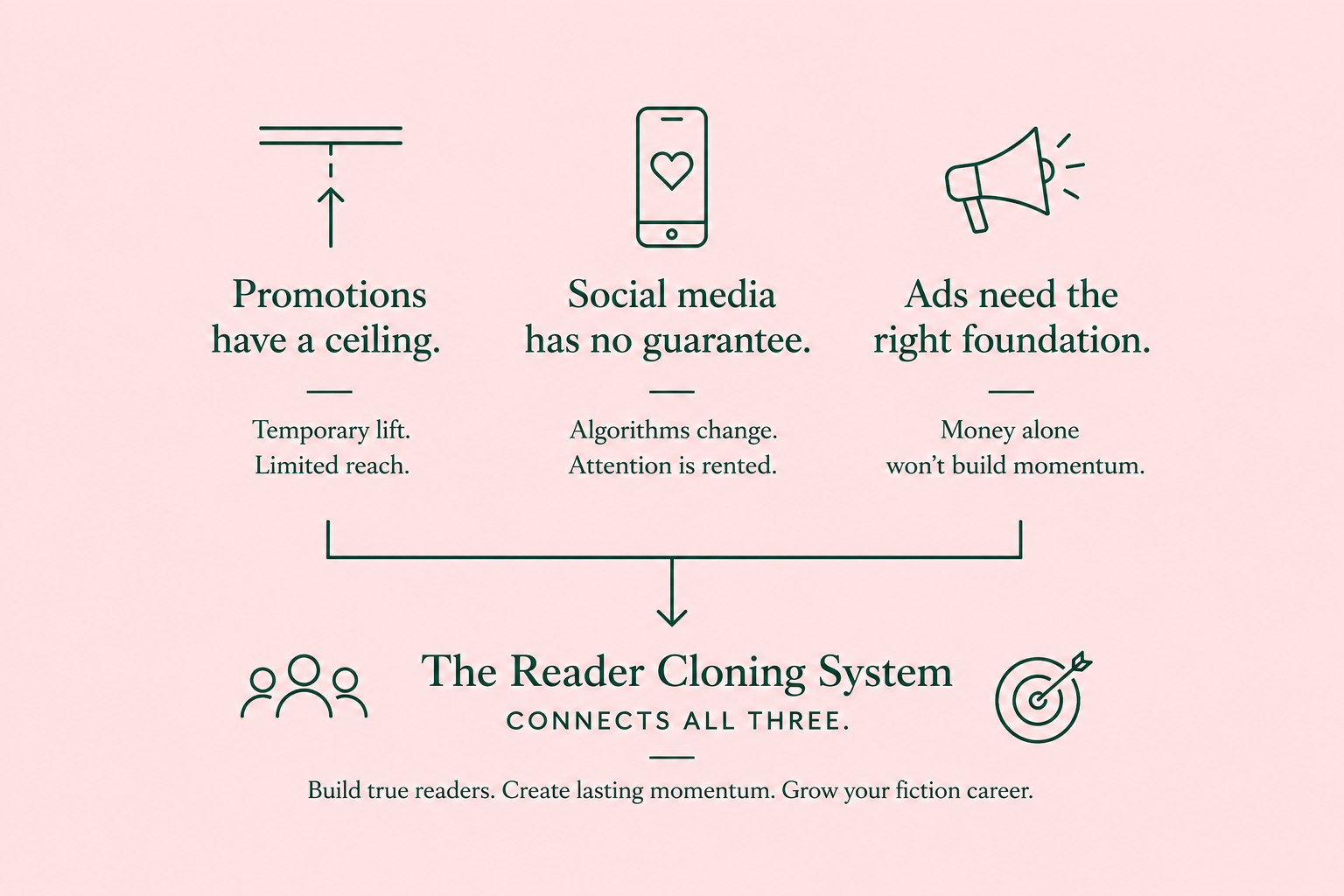
Book promotions can produce a solid ROI, sometimes better than cost-per-click ads in the short term. But their reach does not grow fast enough to run repeatedly, and running the same promotion on the same book eventually produces diminishing returns. Promotions are useful but they have a ceiling.
Social media has the occasional viral moment, but viral does not reliably convert to sales and cannot be engineered consistently. It also requires an enormous amount of time, which becomes the scaling limit. You can only post so much before there are no more hours in the day.
Amazon's new release algorithm gives every book a window of roughly 90 days where active promotion can trigger organic visibility. SEO and metadata strategies can extend that, but they are traffic tools, not compounding systems. They produce a result, and then plateau.
Ads are the most scalable option, but they require the right infrastructure underneath them to work. An ad sending traffic to a product page that does not convert is money disappearing. An ad building readers who do not stick around for the next book is not building anything. This is covered in detail in how book ad metrics actually work for fiction authors, because the metrics problem and the system problem are connected.
The Reader Cloning System was built to solve all of this simultaneously rather than treating each piece as a separate problem.
What the Reader Cloning System Actually Is
The Reader Cloning System is Rebecca's proprietary methodology for identifying your ideal reader and then systematically building an ecosystem that continuously attracts more readers exactly like them, without you having to manually win each one over.
The name comes from the outcome. Instead of acquiring one reader at a time and potentially losing them, the system is designed so that readers you win over stay in your ecosystem and bring in new readers themselves, both directly through recommendations and indirectly through the algorithm signals their behavior creates.
It operates across seven key mechanisms, all taught inside the 3xP Program:
Advanced Metadata, Reviews, Dream Reader Sequencing, Series and Catalog Ecosystem, Trope Mapping, Synergistic Targeting, Reader Psychology, and Algorithmic Launch Code.
Every author gets help with all seven. The order in which they are implemented depends entirely on where the author is in their career when they start.
How the System Is Implemented: The Blueprint
The implementation follows a consistent framework, even though the specifics are different for every author.
Strategy Implementation comes first. Before anything else, Rebecca's team evaluates the author's current position, genre, brand, and goals. The overall strategy frame is consistent, but the specifics of when each element gets activated and what it looks like for that author's catalog is never the same twice. Think of it like a car frame that is identical across models but where the engine, upholstery, paint, and specs are entirely different.
From there, implementation order is determined by career stage.
An author who comes in with an existing catalog and wants to start advertising immediately will focus on ads first, but Trope Mapping will be implemented to make those ads more effective, metadata will be updated to improve organic conversion, and Dream Reader Sequencing will be developed because it directly shapes the Synergistic Targeting of the ad campaigns. All of that is grounded in Reader Psychology. The remaining Trope Mapping elements and launch work come later.
An author who has not yet published will start with Dream Reader Sequencing and a heavier focus on Reader Psychology from the beginning. Cover design briefs, series structure, and catalog ecosystem work happen before the launch. Reviews, advanced metadata, and Synergistic Targeting are built in right before release. Trope Mapping follows after.
The system is designed so that regardless of entry point, every author eventually has all seven mechanisms working together.
Traffic Triggers: Where the Readers Come From
Once the strategy is implemented, traffic starts coming in from multiple sources at once.
Keyword searches driven by metadata improvements. Bestseller list visibility driven by the Series and Catalog Ecosystem combined with Reader Psychology signals. Amazon newsletter placements, also-bought associations, and review velocity, which accelerate around a new release and build more slowly for backlist titles as an indirect benefit of advertising. And ads directly.
Over time, two additional traffic sources build: loyal fans who return for every new release without needing to be re-acquired through ads, and reader recommendations that happen without any prompting.
This is where reader psychology becomes foundational. Readers who finish a book and feel compelled to tell someone about it are not doing that because an author asked them to. They are doing it because the reading experience triggered something. Understanding and engineering that trigger is what separates authors with growing organic visibility from authors who are entirely dependent on paid traffic to maintain their sales. It also directly impacts sell through rates, because readers who feel that pull are the ones who buy the next book.
The Sales Flow and Reader Cloning Flow
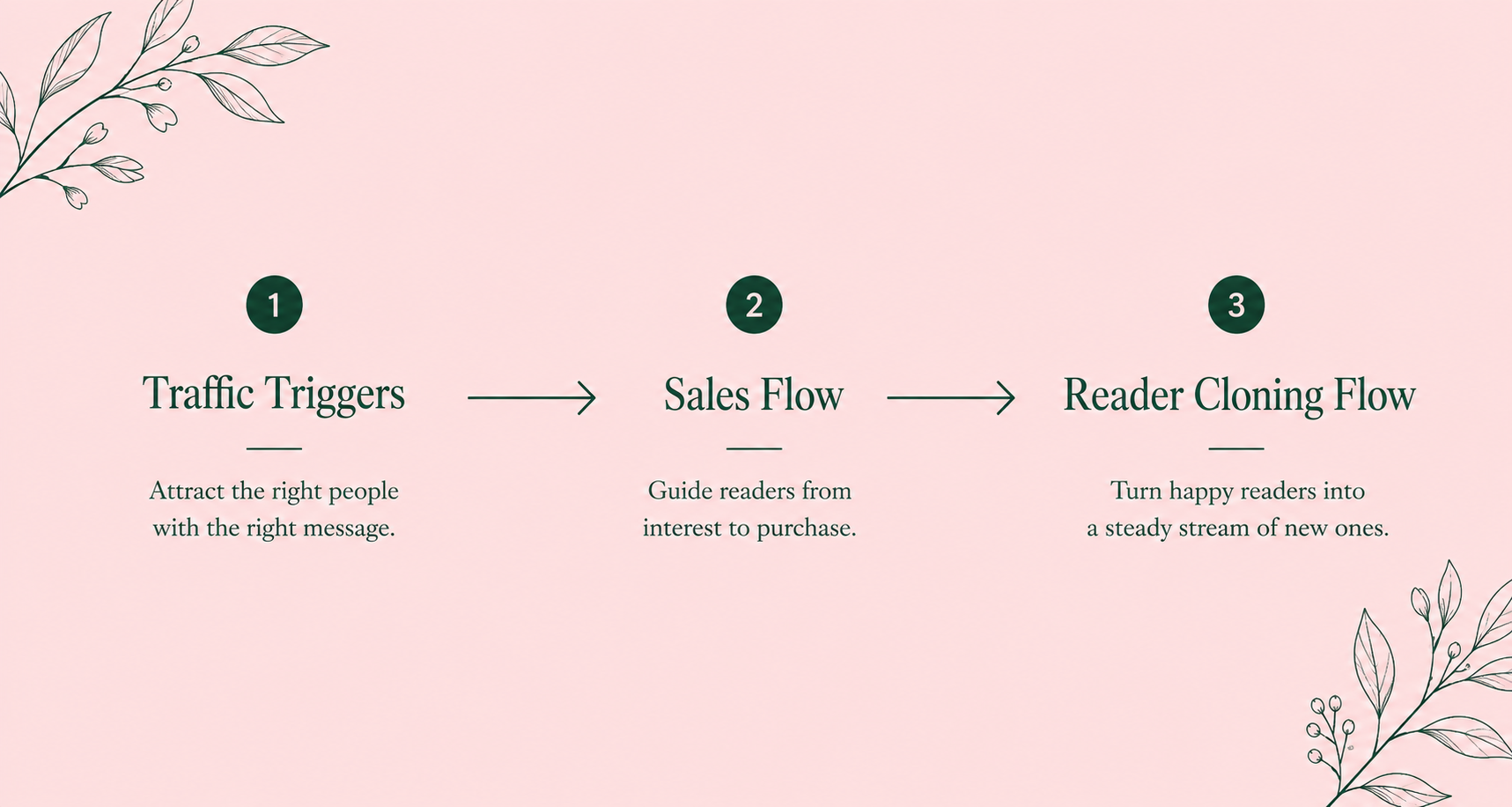
All of that traffic, regardless of where it comes from, funnels to one place: the product page.
Every view that results in a sale is a conversion. And every reader who converts and becomes a superfan adds two things back into the system: they buy more books, and they tell people about your books, either directly through recommendations or indirectly through their reading and purchasing behavior generating algorithm signals.
That creates what Rebecca calls the Reader Cloning Flow:
More people landing on the product page leads to more sales. More sales generate more reviews. More reviews increase both traffic and conversion rates. More conversions generate more budget for ads, which brings in new readers who also enter the reader cloning flow.
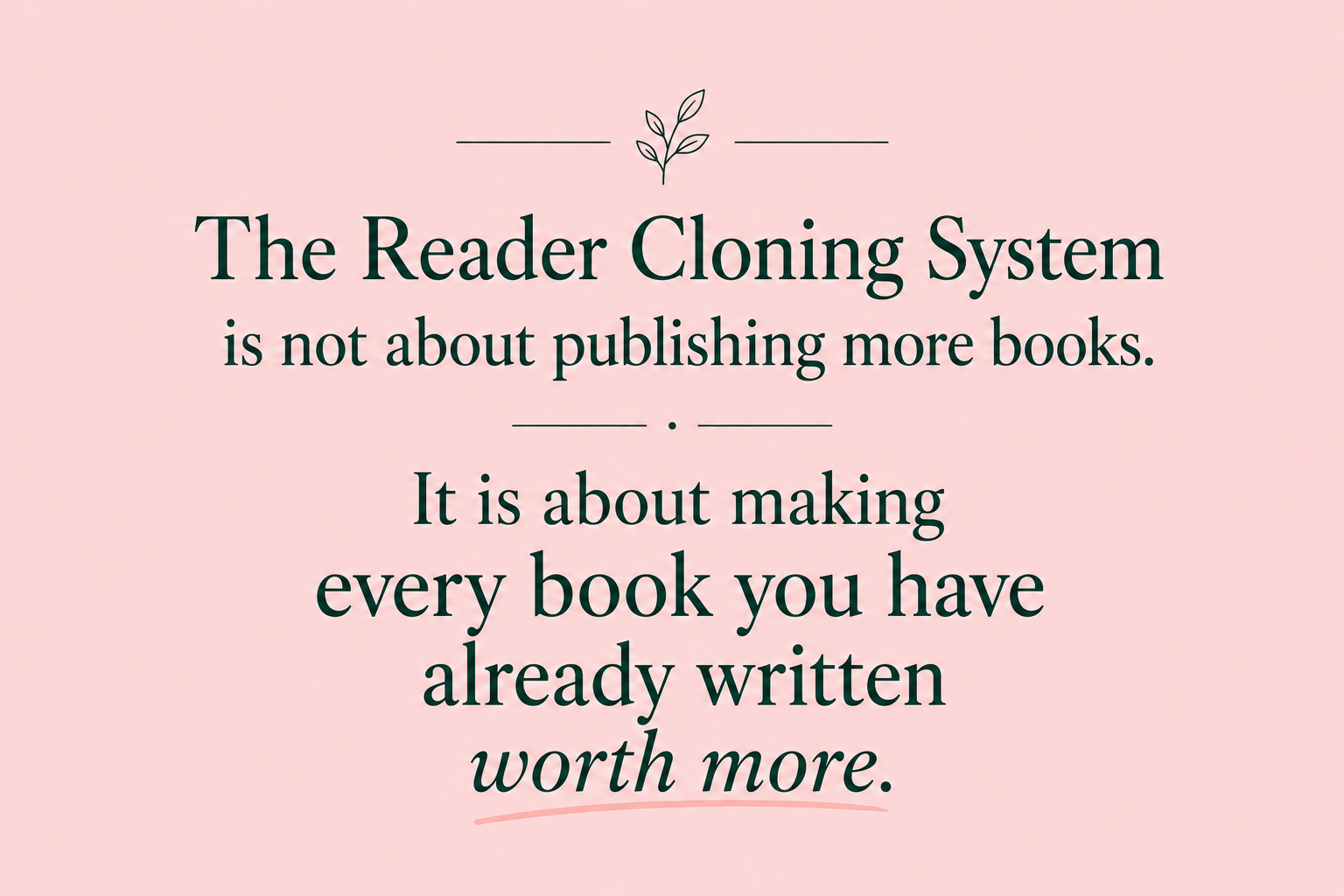
So instead of winning one reader and then needing to go win another from scratch, the system compounds. Each reader won helps win more readers. The catalog grows in value not just because more books are added but because the ecosystem underneath keeps producing returns on books already written.
This is the mechanism behind what actually scales in author marketing and why authors inside the program consistently report making more money while doing less, not because they are working fewer hours but because the system is doing work that does not require their time.
The Multiplication Effect: Why This Is Different From Just Publishing More Books
A common piece of advice in the author world is that the more books you publish, the more money you make. The Reader Cloning System produces a different result than that.
With a standard approach, publishing three series might produce $100k from the first, add $100k from the second for a total of $200k, and add another $100k from the third for $300k total. Linear growth. Each new series adds roughly the same increment.
With the Reader Cloning System in place, the same three series might produce $100k from the first. Two series making $400k total. Three series making $900k total. Each new series multiplies the value of everything already in the catalog rather than just adding to it. This happens because front list activity sells backlist and backlist activity sells front list, driven by the ecosystem underneath rather than by active promotion of each title individually.
This also removes the new release treadmill that traps most authors making between $50k and $500k a year. Many authors at those levels find that their royalties drop the moment they stop releasing. What they have built requires continuous output to maintain rather than continuing to grow without it. This is the royalty ceiling Rebecca covers in depth and the reason authors who feel stuck at a certain income level often stay there no matter how many more books they release.
Royalties are meant to be passive income. The Reader Cloning System is built to make them function that way.
What the Reader Cloning System Requires
The system is not magic and Rebecca does not position it that way. It requires implementation, and implementation requires two things: willingness to follow the data and enough time to do the checkpoint work, which has no deadline attached.
Authors who get the guaranteed results, an additional six figures in net profit, are the ones who complete the full implementation. Results vary when implementation is partial, which is why the money-back guarantee sits only on the programs that include complete mentorship through all seven mechanisms.
It also requires the product side to be in order. Traffic only converts if what it lands on is worth converting on. The five marketability questions are the place to start before expecting any traffic strategy to produce results, and the most common costly mistakes authors make almost all come back to the product not being ready for the system to work on it.
For authors earlier in their career who are building toward readiness, this guide to starting from zero and what the six figure author community actually offers are good starting points before applying.
One Note on Trope Mapping
The term Trope Mapping was coined by Rebecca Hamilton as part of the Reader Cloning System. Since then it has been picked up and used to describe something different by others in the author coaching space.
The distinction matters because real Trope Mapping, as part of this system, produces measurable results in sales that are difficult to miss. If you have heard the term elsewhere and tried what was described without seeing that kind of impact, you were likely implementing a different method under the same name.
How to Find Out If the Reader Cloning System Is Right for You
The 3xP Program includes multiple options depending on where you are in your career and what level of support makes sense. From self-guided training to full one-on-one mentorship with a money-back guarantee.
The first step is a free call with our team where we look at your career, your catalog, and your goals and tell you honestly whether the system is the right fit and which program level would make sense. Applications are open at sevenfigureauthorcareer.com.
You can also join the free Six Figure Fiction Facebook group to get a feel for how Rebecca teaches, see real results from authors at every stage, and get your questions answered before committing to anything.
